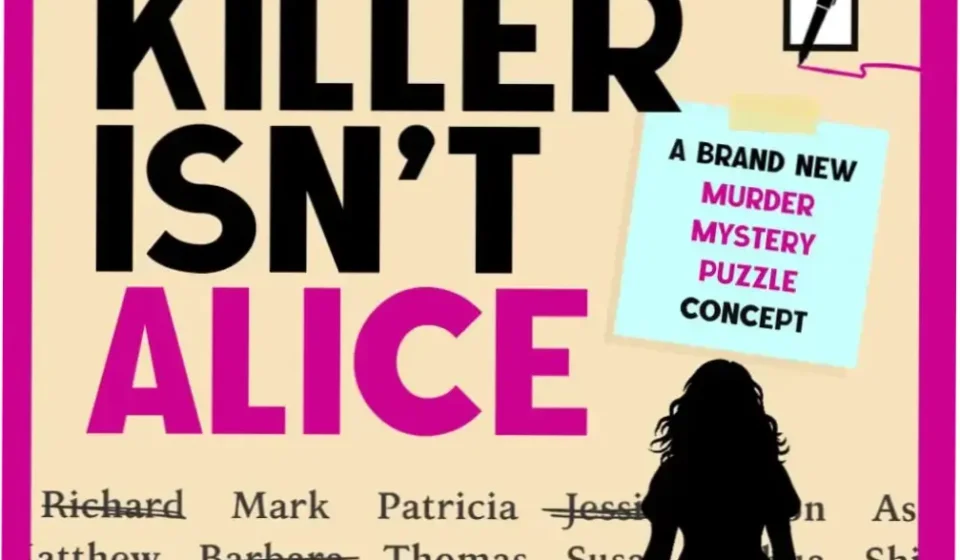

Most modern murder mysteries follow a predictable rhythm: a handful of suspects, a few red herrings, and a dramatic reveal in the final chapter. We’ve been trained to look for the “twist,” but we rarely get to actually do the detective work ourselves. We are passive observers of someone else’s genius.
The market is shifting. Readers are tired of being told who the killer is; they want to prove it. This is where The Killer Isn’t Alice disrupts the genre. It stops being a book and starts being a mechanical logic engine, challenging the reader to handle a volume of data that would make a traditional detective quit.
Ready to dive into “The Killer Isn’t Alice”?
Explore available editions, check current live pricing, or download a free sample directly on Amazon.
Preview Free Sample & Check Price on Amazon
*You will be redirected to Amazon. As an Amazon Associate, we may earn from qualifying purchases.
The “Anti-Novel” Architecture
Let’s be clear: if you are looking for lush prose, character arcs, or a gripping plot, put this book back. This isn’t a novel in the traditional sense. It is a high-stakes elimination game disguised as a paperback.
The structure is brutal in its simplicity. You have 46,600 names. You have 18 clues. Your only goal is to find the one name that survives every single filter.
This shift from narrative to process changes the reading experience entirely. You aren’t reading for “what happens next”; you are reading to execute a search query. It turns the act of reading into a manual database operation.
For some, this is a nightmare. For others, it’s the ultimate dopamine loop. The satisfaction doesn’t come from the story, but from the systematic destruction of the suspect list.
The Learning Curve and the “Wall of Names”
The initial reaction for most readers is sheer panic. Seeing a list of 46,600 suspects is overwhelming. It feels impossible. This is a deliberate psychological hurdle designed by Iris Starling.
The “learning curve” here isn’t about understanding the plot, but about developing a system. You cannot solve this by skimming. You need a pen, a highlighter, and a level of patience that borders on the obsessive.
Early on, the clues feel broad. You might eliminate 10,000 people in one go. That’s the “hook.” That sudden drop in the suspect pool creates a rush of progress that keeps you glued to the pages.
However, as you reach the final clues, the margin for error vanishes. One missed detail or a misread name, and you’ve accidentally eliminated the killer. The tension shifts from “who did it” to “did I mess up the math.”
“It’s not a book, it’s a workout for your brain. I spent three nights with a spreadsheet and a highlighter, and the feeling of finally landing on the one name was better than any plot twist I’ve read in years.”
Logic vs. Intuition: The Brutal Truth
Most mystery fans rely on intuition. They look for the “shady” character or the one with the weird motive. In this puzzle, intuition is useless. In fact, it’s a liability.
The book demands pure, cold logic. If a clue says the killer’s name contains a certain letter or fits a specific pattern, it doesn’t matter if the person “seems” guilty. They are either in or they are out.
This creates a unique intellectual friction. You are forced to ignore your instincts and trust the data. It’s a lesson in objective analysis that mirrors real-world data auditing or forensic accounting.
This is why the book has gained traction on platforms like Reddit and Amazon. It appeals to the “optimizer” mindset—people who love the process of refinement and the purity of a single, verifiable answer.