
We spend most of our adult lives chasing a version of success that usually feels like a moving target. We are conditioned to believe that loss is a failure and that grief is a detour from the “real” path of progress. This obsession with accumulation—of status, possessions, and certainty—often leaves us emotionally bankrupt, staring at a life that looks great on a screen but feels empty in the chest.
Most readers enter the world of Christian Watson expecting a simple collection of “cute” drawings, perhaps a digital detox in book form. However, the reality is a confrontation with the fragility of existence. You can check the current reader reception and availability for How Lucky Am I to see why this specific blend of morbidity and hope has resonated so deeply across social media and traditional publishing.
The book doesn’t try to “fix” the reader with toxic positivity. Instead, it uses the absurd image of a wandering skeleton to ask a fundamental question: What happens when we finally stop fighting the things we cannot control? It is a strategic shift from the “grind culture” toward a philosophy of surrender and acceptance.
Ready to dive into “How Lucky Am I”?
Explore available editions, check current live pricing, or download a free sample directly on Amazon.
Preview Free Sample & Check Price on Amazon
*You will be redirected to Amazon. As an Amazon Associate, we may earn from qualifying purchases.
The Visual Narrative: More Than Just Comic Strips
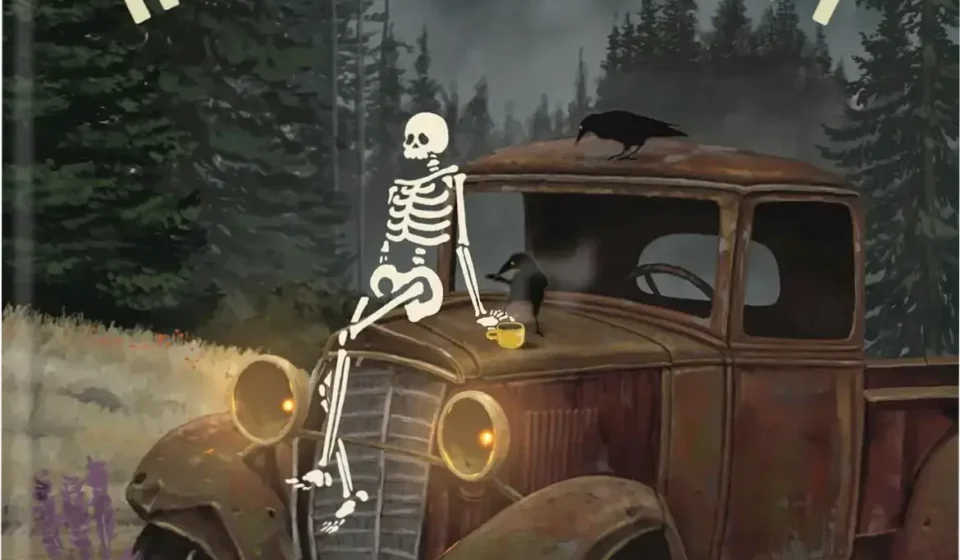
At first glance, the “comic strip” label might lead you to believe this is a light read. It isn’t. Watson uses the character of Mr Skelly not as a mascot, but as a mirror. By stripping the protagonist of flesh, the author removes all markers of race, age, and social class.
The hand-painted imagery creates a stark contrast between the “death” symbol of the skeleton and the “life” of the lush landscapes he traverses. This visual juxtaposition is a technical masterstroke in storytelling; it suggests that peace is possible even when we feel we have already “ended” or lost everything.
The pacing is deliberate. With only 128 pages, the book avoids the fluff common in the self-help genre. It doesn’t lecture; it observes. Each page functions as a meditative beat, allowing the reader to breathe between heavy themes of grief and love.
Deconstructing the Core Philosophy: The Paradox of Loss
The emotional anchor of the book is the provocative statement: “How lucky am I, to have lost what I wanted, to find what I deserved.” This is where Watson moves from illustration to philosophy.
“How lucky am I, to have lost what I wanted, to find what I deserved”
Most of us view loss as a subtraction. Watson frames it as a clearing. The “want” is often an ego-driven desire, while the “deserve” is a soul-driven necessity. This distinction is what drives the narrative forward as Mr Skelly searches for a home.
The “safe home” mentioned in the text isn’t a physical location. It is a psychological state of being. The journey is a metaphor for the process of shedding layers—expectations, traumas, and regrets—until only the essential “bones” remain.
Market Reception vs. Reality: The “Social Media” Effect
There is always a risk when a “social media sensation” moves to hardcover. Often, the depth is shallow, and the aesthetic outweighs the substance. However, the data from Goodreads (4.4 stars) and Amazon (4.9 stars) suggests that Watson has successfully bridged this gap.
Readers on Reddit and other forums frequently mention that the book feels like a “warm hug” or a “gentle reminder.” This indicates that the product is fulfilling a specific market void: the need for emotional validation without the clinical tone of a therapy manual.
The “Best Seller in Comic Strips” status is almost a misnomer. This is a philosophical treatise disguised as a picture book. It targets the “burnt-out millennial” and “anxious Gen Z” demographics who are exhausted by high-pressure performance culture.
| Metric | check the latest verified reviews and current pricing here.
Final Editorial Verdict“How Lucky Am I” delivers on its core promise for its intended audience, offering compelling insights without fluff. As highlighted in our detailed edition breakdown, its practical depth and readability are its greatest strengths. We also recommend checking the official Kindle sample and reader ratings before making your final purchase decision. *You will be redirected to Amazon. As an Amazon Associate, we earn from qualifying purchases. 
|
|---|