
Every parent knows the “Why Phase.” It starts with a simple question about the moon and ends with a three-hour interrogation on how vacuum cleaners work. Most educational books for kids fail because they either treat children like academics with dense blocks of text or treat them like toddlers with oversimplified cartoons that offer zero real substance.
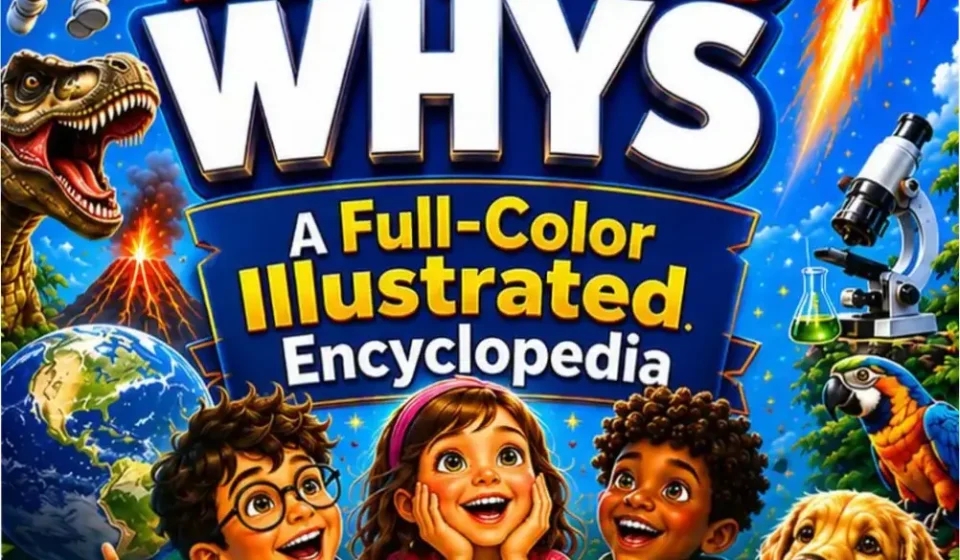
The struggle is finding a resource that satisfies a child’s genuine curiosity without requiring a PhD to navigate. That is where 100,000 Whys for Kids attempts to position itself—not as a textbook, but as a visual map for the naturally curious mind. It aims to bridge the gap between a child’s endless questioning and a parent’s limited patience.
Ready to dive into “100,000 Whys for Kids: A Full-Color Visual Encyclopedia of Big Questions”?
Explore available editions, check current live pricing, or download a free sample directly on Amazon.
Preview Free Sample & Check Price on Amazon
*You will be redirected to Amazon. As an Amazon Associate, we may earn from qualifying purchases.
Visual Strategy vs. Text-Heavy Boredom
Let’s be honest: most kids won’t read a 500-page encyclopedia. Their brains are wired for rapid information acquisition and visual stimulation. Elliott Wonder understands this. The book abandons the “wall of text” approach entirely.
Instead, each page is built around a single, clear question. This is a critical CRO (Conversion Rate Optimization) move for the reader’s attention span. By isolating one “Why” per page, the book prevents cognitive overload.
The use of full-color infographics isn’t just for aesthetics. It’s a pedagogical tool. When a child sees a diagram of a volcano alongside the explanation of why they erupt, the information sticks. It transforms reading from a chore into a visual discovery process.
The “100,000” Paradox: Marketing vs. Reality
As a skeptical analyst, I have to address the elephant in the room: the title. “100,000 Whys” is a bold claim for a 120-page paperback. Mathematically, it’s impossible to fit 100,000 detailed answers in that space.
This is clearly a marketing hook designed to signal “abundance” rather than a literal count. The book actually features 100 curated, high-impact questions across 10 subject areas. While the title is an exaggeration, the value lies in the curation.
Rather than a random list of facts, the book categorizes knowledge into “worlds.” This structure helps kids build mental frameworks. They aren’t just learning about flamingos; they are exploring the “Animal World.”
| Feature | Traditional Encyclopedia | 100,000 Whys Approach |
|---|---|---|
| Layout | Dense columns, small images | One question per page, large visuals |
| Pacing | Linear or Index-based | Dip-in, dip-out exploration |
| Goal | Comprehensive data storage | Sparking curiosity & understanding |
| Reading Style | Studious/Academic | Conversational/Visual |
Bridging the Age Gap (6 to 13 Years)
Targeting a 6-year-old and a 13-year-old with the same book is a risky move. The cognitive difference between those ages is massive. However, the “layered” writing style here manages to pull it off.
The primary explanations are written in simple, accessible language for the younger crowd. But the “quick facts” and “common myths” sections provide the depth that prevents a pre-teen from feeling like they are reading a baby book.
It functions as a “gateway drug” to deeper science. A 7-year-old learns that computers use 1s and 0s. A 12-year-old might be prompted to actually research how binary code works after seeing the visual representation.
Real-World Utility: From Homeschooling to Screen-Free Time
In an era of TikTok-length attention spans, getting a child to engage with a physical book is a battle. This book fights that battle by mimicking the “snippet” nature of digital content but without the blue light.Who Is This Book Actually For?
This isn’t a textbook. It’s a curiosity trigger. The ideal reader is a child between 6 and 13 who is visually driven and easily bored by dense paragraphs. If your kid asks “why” every five minutes but closes a traditional encyclopedia after two pages, this format hits the mark.
It’s particularly effective for homeschooling environments or as a “coffee table” book for kids. The one-page-per-question structure allows for fragmented reading, which fits the modern attention span perfectly.
Who Should Skip This Book?
Be skeptical of the title. While it says “100,000 Whys,” you aren’t getting a hundred thousand individual entries. It’s a curated visual guide. If you are looking for an exhaustive, academic archive of every known fact in the universe, you will find this too lightweight.
Avoid this if your child is already a deep-dive reader who prefers long-form narratives over infographics. This is a gateway book, not a final destination for advanced research.
Value for Money: The Reality Check
From a cost-per-engagement perspective, the value is high. You aren’t paying for the volume of words, but for the curation and visual design. The infographics reduce the “friction” of learning, making it more likely that a child will actually pick it up without being prompted.
The paperback format is durable enough for kids, though the large-format design means it takes up more space than a standard novel. You’re paying for a visual experience that replaces screen time with active discovery.
Editorial Conclusion
Elliott Wonder has created a tool that understands how children actually learn: through patterns, colors, and direct answers. It strips away the fluff and delivers high-gain information in a scannable format.
The book succeeds because it doesn’t try to teach a curriculum; it feeds curiosity. It’s a low-risk investment for parents who want to encourage scientific thinking without the struggle of forcing a child to read a dry manual.
To see if the visual style matches your child’s preferences or to check current pricing, you can browse the user reviews and interior samples on Amazon.
Final Editorial Verdict
“100,000 Whys for Kids” delivers on its core promise for its intended audience, offering compelling insights without fluff. As highlighted in our detailed edition breakdown, its practical depth and readability are its greatest strengths.
We also recommend checking the official Kindle sample and reader ratings before making your final purchase decision.
*You will be redirected to Amazon. As an Amazon Associate, we earn from qualifying purchases.