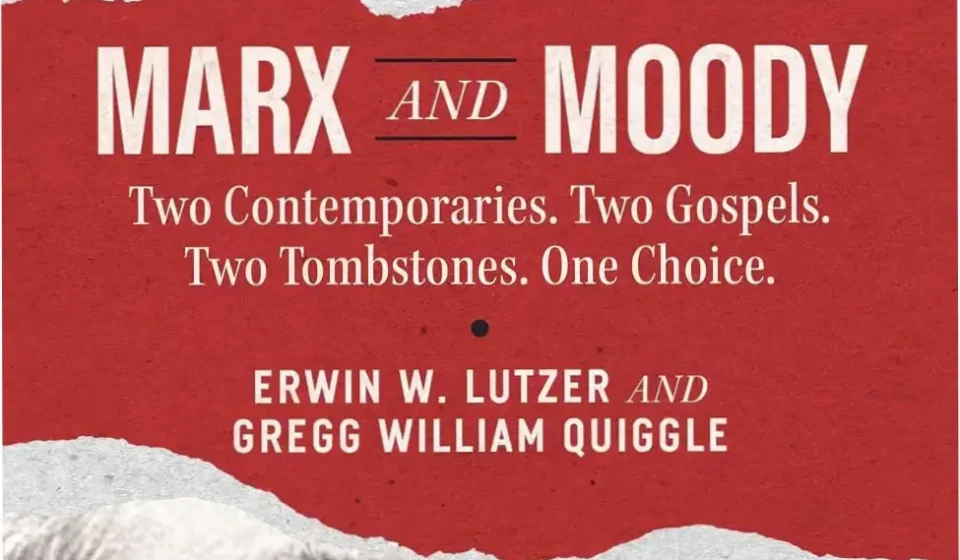

Most people spend their lives chasing a vague version of “freedom.” We are told that liberation comes from changing the system, overthrowing the status quo, or finding a political ideology that finally “fixes” humanity. It is a seductive promise that has fueled revolutions and rewritten borders for over a century.
The problem is that “freedom” is often used as a marketing term for new forms of bondage. When we look at the trajectory of the last 150 years, the clash between man-centered utopias and faith-centered redemption isn’t just a theological debate—it is a matter of historical survival. You can see how these competing legacies play out by checking the current reception of Marx and Moody, where readers grapple with these exact tensions.
Ready to dive into “Marx and Moody: Two Contemporaries. Two Gospels. Two Tombstones. One Choice.”?
Explore available editions, check current live pricing, or download a free sample directly on Amazon.
Preview Free Sample & Check Price on Amazon
*You will be redirected to Amazon. As an Amazon Associate, we may earn from qualifying purchases.
The Anatomy of a Clash: Man vs. God
At first glance, comparing Karl Marx and D.L. Moody seems like an exercise in extremes. One was the architect of a socio-economic theory that attempted to dismantle the class structure of the world. The other was a humble evangelist who sought to dismantle the spiritual barriers between man and God.
However, the brilliance of Lutzer and Quiggle’s analysis lies in the commonality: both men promised liberation. They both looked at a suffering world and said, “There is a better way.” This is where the book becomes a cautionary tale for the modern reader.
The authors argue that Marx’s “gospel” was one of earthly redistribution, which inevitably required state-sponsored coercion. Moody’s “gospel” was one of spiritual transformation, which required personal surrender. The result? One created a trail of tombstones in the millions; the other created a legacy of faith that persists in churches worldwide.
For the skeptical reader, this might seem like a binary oversimplification. But the authors don’t just rely on sentiment. They use the historical record to show that whenever the “center” of a worldview shifts from the Creator to the Creature, the result is an inevitable slide toward authoritarianism.
Writing Style and Intellectual Pacing
This isn’t a dense, academic tome that requires a PhD in Political Science to digest. Lutzer and Quiggle write with a directness that mirrors a courtroom closing argument. The pacing is brisk, alternating between historical biography and theological critique.
The structure is intentionally comparative. By placing the lives of Marx and Moody side-by-side, the book creates a psychological mirror. It forces the reader to ask: “Which promise am I actually buying into?”
The prose is clean and avoids excessive jargon, though it doesn’t shy away from the technicalities of Marxist ideology. It is designed for the “busy believer” or the “curious skeptic” who wants the core arguments without wading through 800 pages of footnotes.
| Feature | Analysis |
|---|