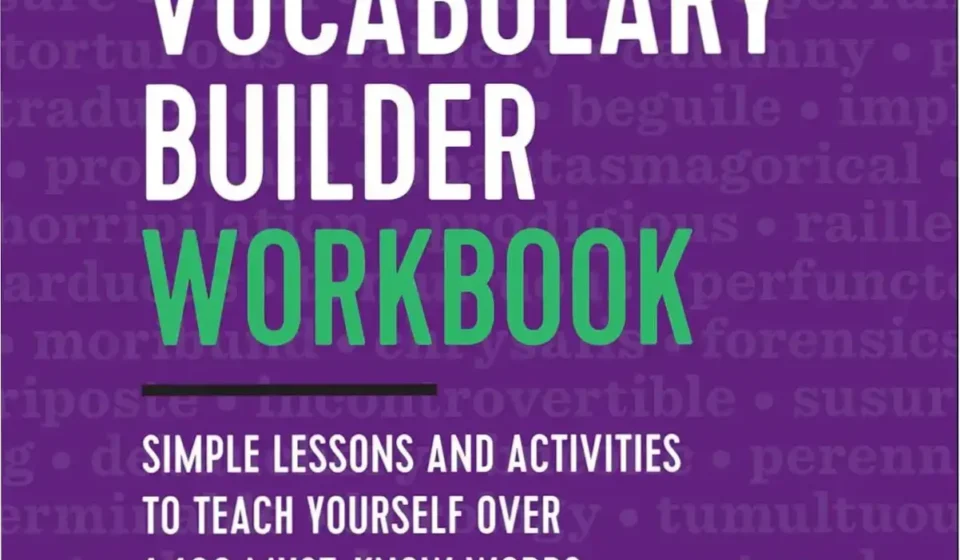

Most people approach vocabulary growth like a memory contest. They buy a stack of flashcards, cram a hundred words into their heads over a weekend, and forget 90% of them by Tuesday. It is a brute-force method that fails because it ignores how the human brain actually stores language.
The real struggle isn’t a lack of memory; it’s a lack of context. When you hit a wall in a professional report or a GRE practice test, you don’t need a dictionary—you need a mental framework to decode unfamiliar terms on the fly. This is where The Vocabulary Builder Workbook attempts to pivot from rote memorization to strategic acquisition.
For students and professionals, the expectation is usually a quick fix. However, the market is flooded with generic lists. Chris Lele’s approach is positioned as a systemic overhaul of how you encounter and retain “must-know” words, moving beyond the superficiality of simple definitions.
Ready to dive into “The Vocabulary Builder Workbook”?
Explore available editions, check current live pricing, or download a free sample directly on Amazon.
Preview Free Sample & Check Price on Amazon
*You will be redirected to Amazon. As an Amazon Associate, we may earn from qualifying purchases.
The Death of the Flashcard: A Root-Based Strategy
Chris Lele doesn’t just give you a list of words; he gives you the “source code.” The workbook focuses heavily on roots, prefixes, and suffixes. This is a critical distinction.
If you memorize the word “benevolent,” you know one word. If you understand the root “bene” (well/good), you suddenly have a map to understand “beneficial,” “benign,” and “benediction.”
This thematic organization transforms the learning process. Instead of isolated islands of information, the book creates clusters. This is why the 4.6-star rating on Amazon is largely justified; it solves the “forgetting curve” problem by creating logical associations.
However, a skeptical reader might ask: is this too academic? For some, the focus on etymology can feel like a linguistics class. But for anyone targeting the SAT or GRE, this is the only way to survive the reading comprehension sections.
Progressive Difficulty and the Learning Curve
The workbook is structured as a ladder. It doesn’t throw you into the deep end with obscure Latinate terms immediately. It starts with foundational words and steadily increases the complexity.
This progressive approach is designed to prevent burnout. Many learners quit vocabulary books because the jump in difficulty is too steep, leading to a feeling of inadequacy.
Lele manages the pacing well. By the time you reach the more challenging sections, you’ve already built the “muscle memory” for how to analyze a word. You aren’t just guessing; you’re calculating the meaning based on previous lessons.
From a CRO perspective, the “workbook” aspect is the real selling point. Passive reading is where learning goes to die. The active exercises force the brain to retrieve information, which is the only way to move a word from short-term to long-term memory.
| Feature | Traditional List | Lele’s Workbook |
|---|---|---|
| Method | Rote Memorization | Root-Based Association |
| Retention | Low (Short-term) | High (Conceptual) |
| Engagement | Passive Reading | Active Exercises |