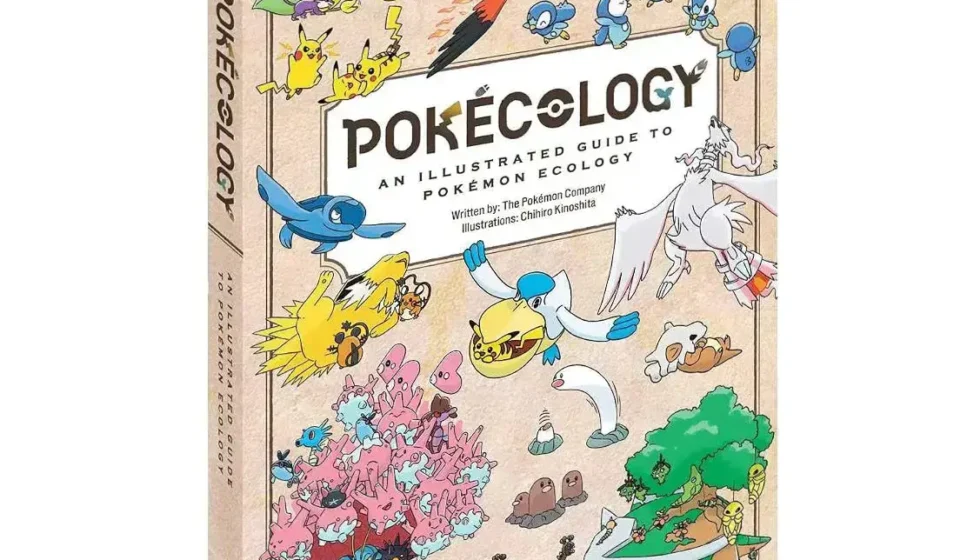

Most Pokémon fans accept the Pokédex entries as gospel, even when they contradict each other or defy the laws of physics. We treat these creatures as game assets with stats and types, rarely stopping to ask how a fire-breathing lizard actually maintains its internal body temperature without incinerating its own organs.
This gap between game mechanics and biological plausibility is where “Pokécology” steps in. Instead of another repetitive art book, it attempts to treat the Pokémon world as a legitimate ecosystem. You can check the current reader reception on Amazon to see if this academic approach to imaginary monsters actually lands with the community.
Ready to dive into “Pokécology An Illustrated Guide to Pokémon Ecology”?
Explore available editions, check current live pricing, or download a free sample directly on Amazon.
Preview Free Sample & Check Price on Amazon
*You will be redirected to Amazon. As an Amazon Associate, we may earn from qualifying purchases.
The PhD Approach: Academic Rigor vs. Fan Fiction
Let’s be direct: most licensed Pokémon books are fluff. They are designed to sell stickers or provide basic lore that you could find in a five-second Google search.
Pokécology is different because of who wrote it. The authors aren’t just writers; they hold doctorates in animal behavior and ecology. This isn’t a coincidence.
They apply actual biological frameworks to the Pokémon universe. They look at niche partitioning, symbiotic relationships, and evolutionary adaptations.
It transforms the reading experience from “look at this cool monster” to “here is why this creature would evolve this specific trait to survive in its environment.”
For the skeptic, this might sound like over-engineering a children’s franchise. However, the result is a cohesive world-building exercise that makes the Pokémon world feel tangible.
Visual Delivery and Information Density
At 208 pages, the book avoids the trap of being an oversized coffee table book with empty space. It is a dense, illustrated guide.
The artwork isn’t just “pretty”; it’s functional. The illustrations serve as visual evidence for the ecological claims being made in the text.
The layout alternates between deep-dive analyses and broader generalities. This prevents the reader from feeling bogged down by the technical jargon.
If you are used to the fragmented nature of the Pokédex, the flow here will feel refreshing. It connects the dots between different species rather than listing them in a vacuum.
| Feature | Standard Pokédex | Pokécology Guide |
|---|---|---|
| Perspective | Data-driven/Fragmented | Ecological/Systemic |
| Authorship | Corporate/Game Dev | PhDs in Ecology/Behavior |
| Focus | Combat & Ability | Survival & Relationship |
| Visuals | Character Art | Contextual Illustrations |
Expectation vs. Reality: Is it Really for Kids?
The official reading age is listed as 8 years and up. On paper, that sounds like a children’s book. In reality, it’s a cross-generational piece.
For a child, it’s a gateway to actual science. It teaches them to think about biology through the lens of something they already love.
For the adult collector, it’s a piece of “speculative biology.” It appeals to the same instinct that makes people enjoy documentaries about deep-sea creatures.
Many readers on Goodreads (where it holds a staggering 4.7 rating) mention that the book feels like a “field guide” from a world that actually exists.
The “reality” is that this book is less about “gaming” and more about “world-building.” If you are looking for battle strategies, you are in the wrong place.
The Learning Curve and Accessibility
Despite the academic credentials of the authors, the book doesn’t read like a textbook. It avoids the dry, sterile tone of a peer-reviewed journal.
The pacing is conversational. It introduces a concept, shows a Pokémon that exemplifies it, and then explains the “why” behind the behavior.
The difficulty level is low, but the intellectual reward is high. It challenges the reader to observe patterns rather than just memorize names.
Who Should Actually Buy This Book?This isn’t a strategy guide. If you are looking for competitive EV spreads or the best move-sets for the current meta, put this book back on the shelf.
Pokécology is designed for a very specific niche: the “Lore Hunter.” It appeals to readers who enjoy speculative biology and world-building. If you’ve ever wondered how a fire-type creature actually breathes or how their diet affects their habitat, this is your goldmine.
The ideal reader profile:
- The Speculative Biologist: Someone who appreciates that the authors hold PhDs in animal behavior and actually apply real-world ecological principles to fictional creatures.
- The Visual Collector: Those who value high-end illustrations over raw data.
- The Curious Child (8+): It serves as an excellent gateway to introduce children to the concepts of ecology and biology through a medium they already love.
The “Buyer’s Remorse” Warning
The most common mistake buyers make is expecting a comprehensive Pokédex. It is not an encyclopedia of every single Pokémon. Instead, it’s a curated analysis of relationships and similarities between species.
If you expect a “Quick Reference Manual,” you will be disappointed. This is a slow-burn, coffee-table style book. You don’t read it for speed; you read it for the “Aha!” moments where a fictional design suddenly makes biological sense.
Quick Analysis: Value for Money
At 208 pages, you aren’t paying for volume, but for intellectual curation. Most Pokémon books are just collections of official art. This one adds a layer of academic rigor that justifies the price point for collectors.
| Pros | Cons |
|---|---|
| Academic approach to lore | Not a complete species list |
| Stunning, vivid illustrations | Zero utility for gameplay strategy |
| High-quality paperback build | Niche appeal (Speculative Bio) |
Editorial Verdict
Pokécology succeeds because it treats Pokémon as real animals rather than just game assets. It bridges the gap between a children’s comic and a scientific journal without becoming boring.
It is a sophisticated piece of fan-service that respects the reader’s intelligence. If you value the “why” and “how” of the Pokémon world more than the “how to win,” it’s a mandatory addition to your library. You can verify the current pricing and read more unfiltered user experiences via the official product page.
Final Editorial Verdict
“Pokécology: An Illustrated Guide to Pokémon Ecology” delivers on its core promise for its intended audience, offering compelling insights without fluff. As highlighted in our detailed edition breakdown, its practical depth and readability are its greatest strengths.
We also recommend checking the official Kindle sample and reader ratings before making your final purchase decision.
*You will be redirected to Amazon. As an Amazon Associate, we earn from qualifying purchases.