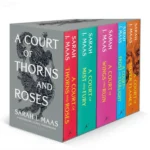

Most readers know the feeling of an emotional hangover after a massive series climax. You’ve survived the war, the villains are gone, and you’re left wondering: “Now what?” This is the precise psychological space Sarah J. Maas occupies in this installment.
The challenge isn’t fighting a monster; it’s the grueling, quiet work of picking up the pieces. Many enter this book expecting another epic clash, but they find a domestic study of PTSD and reconstruction. If you want to see how the community currently rates this shift in tone, you can check the current reception of the book on Amazon.
Ready to dive into “A Court of Frost and Starlight”?
Explore available editions, check current live pricing, or download a free sample directly on Amazon.
Preview Free Sample & Check Price on Amazon
*You will be redirected to Amazon. As an Amazon Associate, we may earn from qualifying purchases.
The “Bridge” Dilemma: Pacing and Format
Let’s be direct: this is not a novel. It is a novella. At 272 pages, it lacks the traditional narrative arc of the previous books.
There is no central antagonist. There is no ticking clock. The “plot” is essentially a series of conversations during the Winter Solstice.
For some, this is a refreshing breather. For others, it feels like filler. The pacing is glacial compared to the high-stakes adrenaline of A Court of Wings and Ruin.
If you are looking for a plot-driven experience, you will be disappointed. This is a character study disguised as a fantasy story.
The Weight of Aftermath: Trauma and Healing
Where the book actually succeeds is in its exploration of war scars. Maas shifts the focus from physical battles to psychological ones.
Feyre’s transition to High Lady isn’t a fairytale. It’s a lesson in managing the grief of others while trying to hide her own.
The narrative captures the “invisible” wounds. The way a simple celebration can trigger a panic attack or a memory of loss is handled with surprising nuance.
It highlights a real-world truth: the end of a conflict is just the beginning of the recovery. The “happily ever after” is actually a lot of hard work.
“The war was over, but the battle for peace was just beginning.”
Expectation vs. Reality: The Reader’s Divide
The divide in reviews on Goodreads and Reddit is stark. You have the “loyalists” and the “skeptics.”
Loyalists love the “fluff.” They want to spend more time with the Inner Circle and enjoy the domesticity of the Night Court.
Skeptics find it tedious. They argue that the book could have been a few chapters at the end of the previous novel rather than a standalone release.
The reality is that this book serves a purely functional purpose. It exists to set the stage for the shift in perspective seen in A Court of Silver Flames.
Without the tension established here—specifically regarding Nesta and Cassian—the subsequent books lose their emotional grounding.
| Reader Profile | Likely Verdict | Reasoning |
|---|---|---|
| The Lore Hunter | Mixed | Low on new world-building, high on character fluff. |
| The Romantic | Positive | Enjoys the tenderness and intimacy of the couples.
Who Should Actually Read This?Let’s be clear: A Court of Frost and Starlight is not a novel. It is a bridge. If you are looking for the high-stakes warfare or the intense romantic tension of the previous books, you will be disappointed. This book is designed for a very specific profile: the completionist. If you are emotionally invested in the psychological recovery of the Night Court characters and want to see the “aftermath” of the war, this is for you. You should probably SKIP this if:
Value for Money: The “Bridge Book” DilemmaAt 272 pages, the value proposition is debatable. You are paying for atmosphere and closure, not for a sprawling epic. Many readers mistake this for a full-length installment and feel cheated by the lack of a central conflict. The reality? It’s a narrative palate cleanser. It transitions the series from the collective struggle of the war to the individual struggles explored in A Court of Silver Flames. While the price-to-page ratio is higher than the main novels, the emotional payoff for loyal fans justifies the cost. Editorial Conclusion: Expectations vs. RealitySarah J. Maas trades her usual explosive pacing for a slow, meditative look at PTSD and reconstruction. It is less of a story and more of a series of vignettes. The writing remains evocative, but the lack of a traditional arc makes it feel like an extended epilogue. However, for those who view these characters as friends, the intimacy of the Winter Solstice celebrations provides a necessary breath of air before the next storm. If you’re unsure whether the pacing fits your style, the best move is to check the latest reader reviews and pricing on Amazon to see if the community consensus aligns with your reading preferences. Final Editorial Verdict“A Court of Frost and Starlight” delivers on its core promise for its intended audience, offering compelling insights without fluff. As highlighted in our detailed edition breakdown, its practical depth and readability are its greatest strengths. We also recommend checking the official Kindle sample and reader ratings before making your final purchase decision. *You will be redirected to Amazon. As an Amazon Associate, we earn from qualifying purchases. 
|