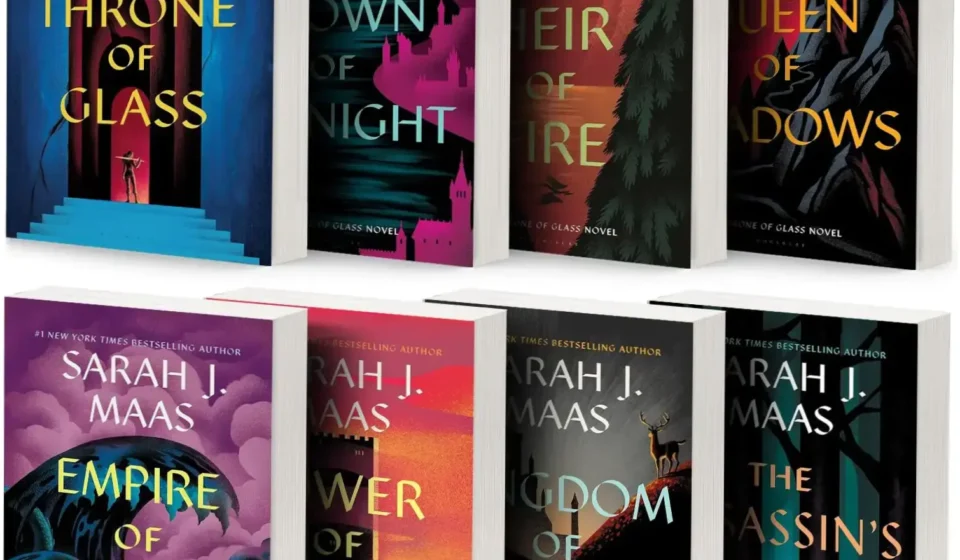

Most readers today suffer from “commitment anxiety.” We want the immersive escape of a sprawling epic, but the thought of a 5,000-page odyssey feels like a second full-time job. We crave a world where stakes actually matter, yet we’re often met with predictable tropes and flat characters.
Sarah J. Maas entered this void not just as a writer, but as an architect of obsession. The Throne of Glass series isn’t just a collection of books; it’s a case study in how to evolve a narrative from a simple “assassin competition” into a global war epic. If you are wondering if this massive investment of time is worth it, you can check the current reader reception and availability here before diving in.
Ready to dive into “Throne of Glass Series Collection”?
Explore available editions, check current live pricing, or download a free sample directly on Amazon.
Preview Free Sample & Check Price on Amazon
*You will be redirected to Amazon. As an Amazon Associate, we may earn from qualifying purchases.
The Evolution of Scale: From YA Competition to High Fantasy
One of the most jarring—and eventually rewarding—aspects of this series is its growth. The first book, Throne of Glass, reads like a traditional Young Adult novel. It’s contained. It’s a competition in a castle. It’s almost “small” compared to what comes later.
Maas doesn’t stay in the castle. By the time you hit Heir of Fire, the scope explodes. The narrative shifts from “will she win the competition?” to “can she save the world from an ancient evil?”
This transition is where many readers either fall in love or drop the series. Skeptics often argue that the early books feel like a different series entirely. However, from a technical storytelling perspective, this mirrors the protagonist’s own awakening. As Celaena discovers who she really is, the world expands to match her power.
The pacing in the latter half of the collection—specifically Empire of Storms and Kingdom of Ash—is relentless. Maas trades the intimacy of the early books for massive battle sequences and complex political maneuvering across multiple continents.
Character Architecture: The Deconstruction of an Assassin
Celaena Sardothien is not your typical “strong female lead.” In the beginning, she is arrogant, vain, and obsessed with luxury—traits that make her human and flawed.
The real value of this 8-book set is watching the systematic stripping away of those layers. Maas uses trauma and loss to pivot the character from a survivor to a leader. This isn’t a linear progression; it’s a messy, emotional struggle.
The supporting cast is equally layered. The romance is a “slow-burn” in the truest sense of the word. It doesn’t distract from the plot; it fuels it. The relationships are built on mutual respect and shared trauma rather than instant attraction tropes.
“The most dangerous thing about her wasn’t her blade, but her capacity to endure.”
This quote encapsulates the series’ core philosophy. It’s less about the magic and more about the psychological resilience required to face an impossible destiny.
The “Assassin’s Blade” Dilemma: Narrative Structure
The inclusion of The Assassin’s Blade in this collection is a critical point of discussion among the fandom. This is a collection of prequel novellas.Who This Collection Is Actually For
The Throne of Glass series isn’t a casual read; it’s a commitment. This set is designed for readers who crave “world-immersion”—those who enjoy watching a character evolve from a desperate prisoner into a geopolitical powerhouse over thousands of pages.
If you enjoy the “slow burn” trope—not just in romance, but in plot revelation—this is your territory. The narrative architecture is built on long-term payoffs. You will spend three books wondering about a specific secret only to have it explode in the sixth. For the patient reader, this is rewarding. For the impatient, it’s frustrating.
Who Should Probably Skip It
Avoid this 8-book set if you fall into these categories:
- The “Fast-Paced” Purist: If you prefer tight, 300-page standalone novels, 5,008 pages of sprawling fantasy will feel like a chore.
- Anti-Trope Readers: While Maas subverts some expectations, the series still leans heavily into “chosen one” and “destined love” archetypes.
- Minimalists: If you don’t have the shelf space or the mental bandwidth for a narrative that requires keeping track of dozens of characters across multiple continents, stick to a shorter series.
The Value Proposition: Set vs. Individual Buys
From a purely financial standpoint, the collection is the only logical move. Buying these eight volumes individually is a budget killer. You are essentially paying for the convenience of a curated library.
However, the “value” here is also about the reading order. With the inclusion of The Assassin’s Blade, the set allows you to integrate the prequels at the optimal moment (usually after book three), which fundamentally changes the emotional impact of the later novels.
Editorial Verdict: Is it Worth the Hype?
The series succeeds because it scales. It starts as a localized competition in a castle and ends as a continental war. The technical quality of the writing evolves as the author grows, meaning the later books are significantly more sophisticated than the first.
The only real risk is “fantasy burnout.” By the time you reach Kingdom of Ash, the stakes are so high they almost become abstract. But for those who want a complete emotional journey with a definitive ending, it is a gold standard of the genre. You can check current reader sentiment and updated pricing for the complete 8-book collection here.
Final Editorial Verdict
“Throne of Glass Series Collection” delivers on its core promise for its intended audience, offering compelling insights without fluff. As highlighted in our detailed edition breakdown, its practical depth and readability are its greatest strengths.
We also recommend checking the official Kindle sample and reader ratings before making your final purchase decision.
*You will be redirected to Amazon. As an Amazon Associate, we earn from qualifying purchases.