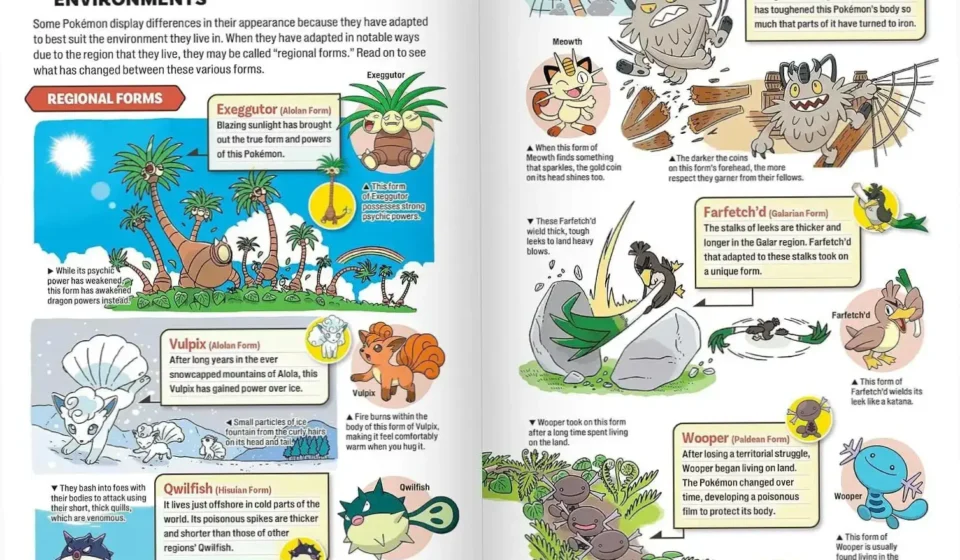

Most Pokémon fans treat the Pokédex as a digital checklist—a collection of stats, types, and brief flavor text. But there is a glaring gap between knowing a Pokémon’s attack power and understanding how it actually survives in a wild, competitive ecosystem. We are used to seeing these creatures in vacuum-sealed battle arenas, not as biological entities with dietary needs and territorial disputes.
This is where Pokécology: An Illustrated Guide to Pokémon Ecology attempts to bridge the divide. Instead of another generic strategy guide, this work treats the Pokémon world as a legitimate field of biological study, challenging the reader to look past the game mechanics and see the “animals” behind the pixels.
Ready to dive into “Pokécology An Illustrated Guide to Pokémon Ecology”?
Explore available editions, check current live pricing, or download a free sample directly on Amazon.
Preview Free Sample & Check Price on Amazon
*You will be redirected to Amazon. As an Amazon Associate, we may earn from qualifying purchases.
Academic Rigor vs. Fan Service: The PhD Factor
The first thing that catches your eye isn’t the art, but the credentials. The author and illustrator both hold doctorate degrees in animal behavior and ecology. On paper, this sounds like overkill for a book about fictional monsters.
In practice, it’s the book’s greatest strength. They don’t just say “Pikachu lives in the forest.” They analyze the similarities and differences between Pokémon ecologies using actual biological frameworks.
It transforms the reading experience from a passive stroll through a gallery into an active exercise in observation. You start questioning why certain Pokémon share traits and how those traits would realistically function in a food chain.
However, a skeptic might ask: does the academic approach stifle the magic? Not really. It actually enhances it by adding a layer of “pseudo-realism” that makes the world feel lived-in rather than just programmed.
Visual Storytelling and Data Density
At 208 pages, the book avoids the trap of being a bloated coffee table piece. It is dense, but the density is managed through high-quality illustrations that serve as data points rather than just decoration.
The artwork is “spectacular,” as the marketing claims, but its real value is in the context. The illustrations highlight the relationships between species—how one Pokémon’s habitat affects another’s survival.
The layout is designed for the “scanner.” You can flip through and grasp the core ecological concept of a region or species in seconds, or you can dive deep into the analysis.
| Feature | Standard Pokédex | Pokécology Guide |
|---|---|---|
| Focus | Stats & Abilities | Behavior & Habitat |
| Perspective | Collector’s Log | Biological Thesis |
| Visuals | Character Sprites | Ecological Illustrations |
| Goal | Completion (Catch ‘em all) | Understanding (Study ‘em all) |
The Learning Curve: Who is this actually for?
There is a strange contradiction in the specifications: “Reading age 10+ years” but “Grade level 1-2.” This is likely a metadata error, but it points to the book’s dual nature.
For a 10-year-old, this is a gateway to actual science. It teaches the basics of ecology—niches, symbiotic relationships, and adaptation—using characters they already love.
For the adult collector, it’s a sophisticated piece of lore expansion. It fills the gaps that the games leave open, providing a cohesive narrative for how the Pokémon world actually functions.
If you are looking for a “how-to-win” guide or a list of where to find rare spawns, you are in the wrong place. This is a book of “why,” not “where.”
Expectation vs. Reality: The Skeptic’s View
Going into
Who is this book actually for?
This isn’t your standard Pokédex reprint. It is designed specifically for the “lore-hound.”
The ideal reader is someone who asks why a Pokémon lives in a specific cave or how its anatomy supports its survival. If you enjoy speculative biology or nature documentaries, this hits the spot.
It also serves as an excellent bridge for parents wanting to introduce basic biological concepts to children aged 10+ through a medium they are already obsessed with.
Who should skip Pokécology?
If you are searching for competitive battle strategies, EV training, or “best team” lists, put this book back. You will find zero tactical gaming advice here.
Similarly, if you prefer fast-paced, light reading, the academic approach—backed by authors with PhDs—might feel too dense or overly detailed for a casual coffee-table flip.
The “Buyer’s Trap”
The most common purchasing mistake is treating this as a game manual. It is a study of ecology, not a guide to winning the Pokémon League.
Many buyers expect a simple “Who’s that Pokémon” picture book. Instead, they get a deep dive into environmental adaptations and species relationships. It’s a textbook for a fictional world, not a toy.
Quick Reality Check
- Is it too academic? No, but it is structured like a scientific journal.
- Are the illustrations useful? Yes, they provide the visual evidence for the ecological claims made in the text.
- Is it worth the price? As a collector’s piece or educational tool, yes. For a casual gamer, it’s a luxury, not a necessity.
Ultimately, Pokécology succeeds by treating the Pokémon world with a level of scientific rigor usually reserved for real-world zoology. It transforms a gaming franchise into a believable, breathing ecosystem.
If you are curious about how these creatures would actually survive in the wild, you can check the latest reader ratings and current pricing on Amazon.
Final Editorial Verdict
“Pokécology An Illustrated Guide to Pokémon Ecology” delivers on its core promise for its intended audience, offering compelling insights without fluff. As highlighted in our detailed edition breakdown, its practical depth and readability are its greatest strengths.
We also recommend checking the official Kindle sample and reader ratings before making your final purchase decision.