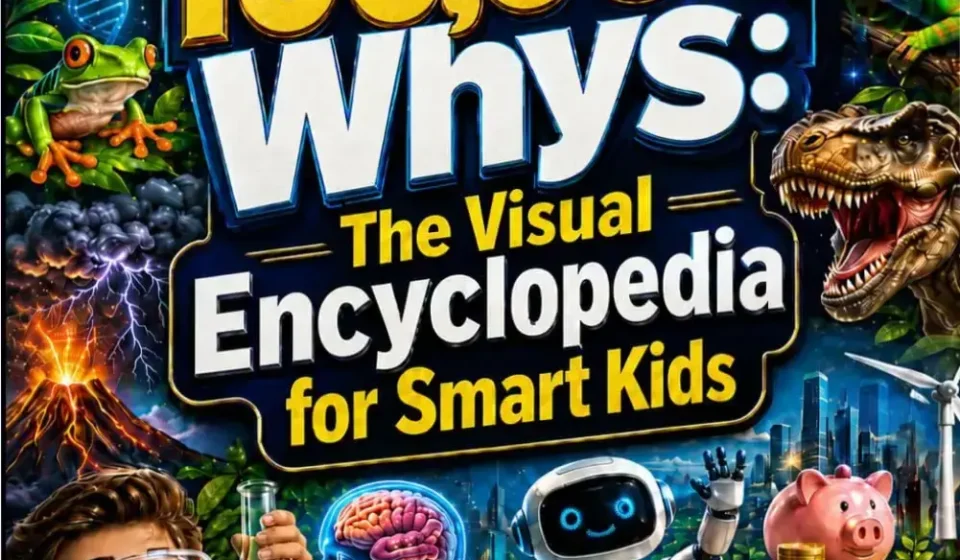

Every parent knows the “interrogation phase.” It starts around age six and doesn’t stop until the child is probably thirty. “Why is the sky blue?” is the entry-level question, but it quickly evolves into “Why do we have to pay taxes?” or “How does a black hole actually work?”
The struggle isn’t the curiosity—it’s the adult’s ability to provide an answer that is scientifically accurate yet simple enough not to bore a ten-year-old. Most encyclopedias fail here; they are either too academic or too childish. You can check the current reader reception and availability of 100,000 Whys for Smart Kids to see how it handles this delicate balance.
Ready to dive into “100,000 Whys for Smart Kids”?
Explore available editions, check current live pricing, or download a free sample directly on Amazon.
Preview Free Sample & Check Price on Amazon
*You will be redirected to Amazon. As an Amazon Associate, we may earn from qualifying purchases.
The “Anti-Textbook” Architecture
Let’s be honest: most kids hate textbooks. They are linear, dry, and demand a level of focus that the modern, dopamine-driven brain struggles with. Jennifer L. Trace and James H. Jordan seem to understand this. They didn’t write a manual; they wrote a map of curiosities.
The pacing is intentionally fragmented. It uses a “snackable” content delivery system. This means a child can open to any random page, find a weird fact about the human brain, and close the book two minutes later feeling like they’ve won a prize.
From a CRO perspective, the book’s “user experience” is designed for the reluctant reader. By breaking complex ideas into short, punchy explanations, it lowers the barrier to entry. It doesn’t ask the child to commit to a chapter; it asks them to commit to a single “Why.”
“The brilliance isn’t in the depth of the science, but in the accessibility of the delivery. It transforms learning from a chore into a scavenger hunt.”
Breadth vs. Depth: The Skeptic’s View
Here is where we need to be critical. The title claims “100,000 Whys.” Mathematically, in a 180-page book, that is impossible. It’s a marketing hook, not a literal count. If you’re expecting a comprehensive academic tome, you’ll be disappointed.
However, the breadth is where the value lies. Most kids’ science books stick to the “Big Three”: Space, Dinosaurs, and the Ocean. This book pivots into more practical, “grown-up” territories like money, choices, and technology.
This inclusion of “soft sciences” and life skills is a smart move. It acknowledges that a 10-year-old isn’t just curious about Saturn’s rings—they are curious about why adults make the decisions they do and how the economy works in a way that doesn’t involve a boring lecture.
| Feature | Expectation | Reality |
|---|---|---|
| Quantity of Facts | 100,000 distinct answers | Curated selection of high-impact “whys” |
| Tone | Educational/Academic | Playful, conversational, and fast |
| Reading Level | Standard 6-12 range | Highly accessible, even for reluctant readers |
| Scope | Pure Science | Hybrid: Science, Tech, Finance, and Psychology |
Gamifying Curiosity: The Brain Challenges
The inclusion of 500 brain challenges is the “secret sauce” here. It shifts the child from a passive consumer of information to an active participant. This is basic cognitive psychology: we remember things better when we have to solve for them.
These challenges act as a mental palate cleanser. After reading a few facts about the human body, the brain
Who This Book Is Actually For
This isn’t a textbook; it’s a curiosity engine. The ideal reader is the child who exhausts their parents with a non-stop stream of “why” questions during dinner or car rides. It specifically caters to reluctant readers—kids who find dense paragraphs intimidating but can spend hours flipping through a book of “weird facts.”
If your child enjoys fragmented learning, visual cues, and rapid-fire information, this is a win. It transforms learning from a chore into a scavenger hunt.
Who Should Skip It
Avoid this purchase if you are looking for a comprehensive, academic reference guide. If your goal is a deep, sequential dive into a single subject (like a dedicated astronomy or biology tome), this broad-stroke approach will feel too superficial.
Additionally, parents expecting a literal count of 100,000 distinct, detailed answers will be disappointed. The title is a marketing hook for the spirit of curiosity; in 180 pages, you get a curated selection of high-impact facts and challenges, not an exhaustive database.
Value Analysis & Realistic Expectations
At 180 pages, the value lies in the density of engagement rather than the volume of text. The inclusion of 500 brain challenges adds a layer of interactivity that prevents the book from becoming a passive reading experience.
- The Win: High “screen-free” utility. Perfect for road trips or bedside reading.
- The Trade-off: Breadth over depth. It introduces topics but doesn’t master them.
- The Risk: The “100,000” claim is hyperbolic, which might annoy a strictly literal-minded child.
Editorial Verdict
The book succeeds because it respects a child’s attention span. By breaking complex ideas into “clear explanations,” it builds confidence in young learners. It doesn’t try to teach a curriculum; it tries to foster a habit of questioning the world.
For most parents, the cost is a small price to pay for a tool that encourages critical thinking and independent exploration. To see if the visual style matches your child’s preferences, you can check the current reader ratings and interior samples on Amazon.
Final Editorial Verdict
“100,000 Whys for Smart Kids” delivers on its core promise for its intended audience, offering compelling insights without fluff. As highlighted in our detailed edition breakdown, its practical depth and readability are its greatest strengths.
We also recommend checking the official Kindle sample and reader ratings before making your final purchase decision.
*You will be redirected to Amazon. As an Amazon Associate, we earn from qualifying purchases.